
How to Track Restaurant Inventory: A Step-by-Step Guide
TL;DR
Restaurants lose 5–10% of revenue to inventory they cannot see. Track stock weekly, calculate usage variance against your sales data, and fix discrepancies the same day to stop profit from bleeding out quietly.
Why Inventory Tracking Matters
87%
of operators saw food costs rise in 2024
$5,200
lost per year on a single mis-tracked ingredient
Restaurant profit margins sit between 3% and 5%. In 2024, 87% of operators saw food costs rise. In 2025, 82% expect further increases. There is no room for error.
When you do not track restaurant inventory accurately, you bleed cash. Spices and garnishes are over-ordered and left to expire. High-value proteins are over-portioned. Stock disappears from the walk-in without a trace.
Consistent restaurant inventory tracking fixes this. It controls food costs by catching over-portioning and theft before they ruin your month. It reduces waste by stopping the over-ordering of perishables and connects directly to the same loss factors we cover in our food waste guide. It protects your profitability by ensuring you only buy what you actually sell.
The industry scale of this problem is staggering. ReFED data shows U.S. restaurants and foodservice businesses generated 12.5 million tons of surplus food in 2024, with more than 85% going straight to landfill. Waste tracking ranks as the single highest-impact solution for foodservice operators, with a projected $2 billion in annual industry-wide savings.
The Step-by-Step Inventory Tracking System
Getting your inventory under control requires a repeatable process. Follow these five steps to build a system that works.
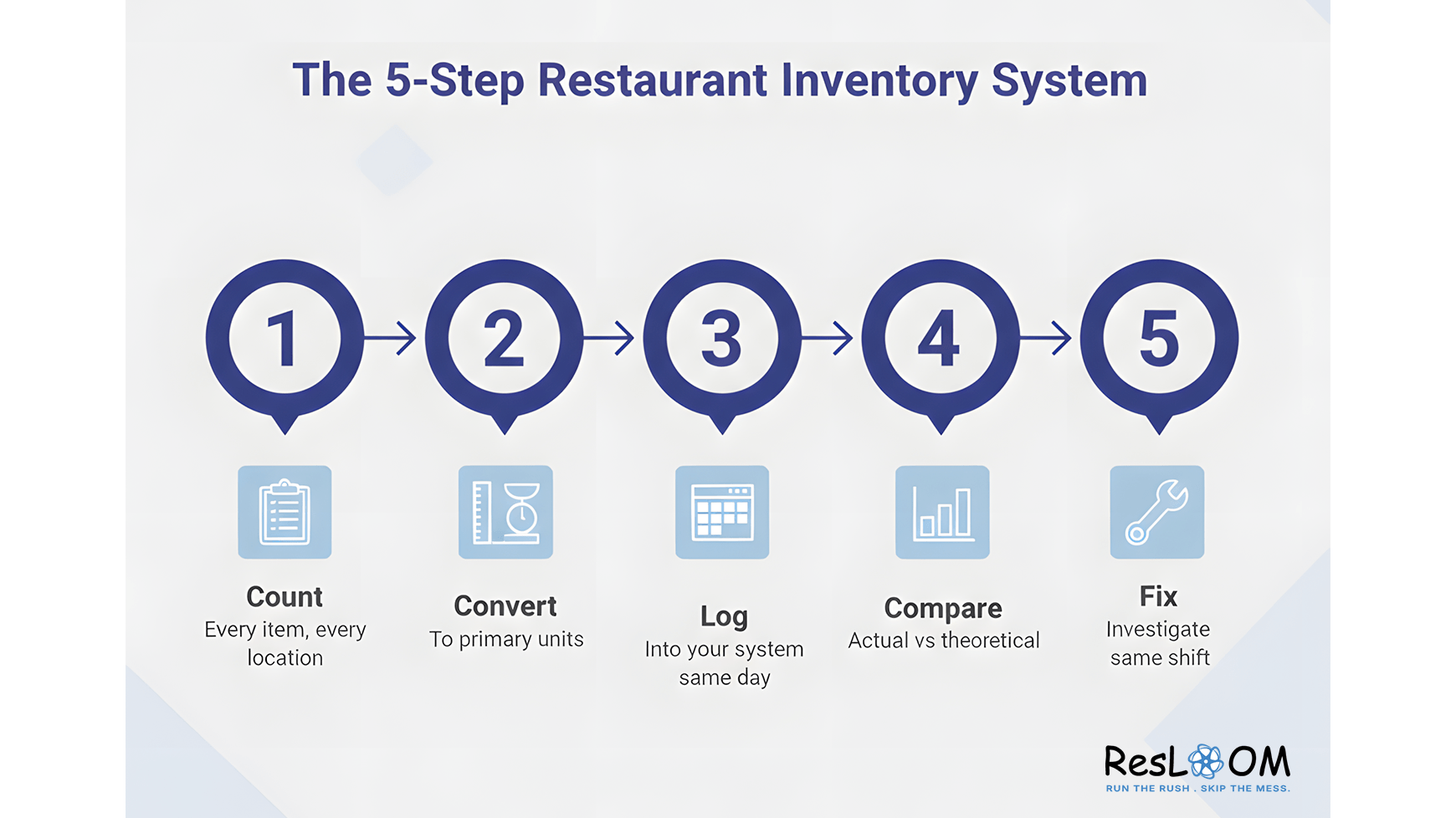
List all ingredients and standardize units
You cannot manage what you do not name. Create a master list of every item in your restaurant. Group them by category: produce, meat, dairy, dry goods, and alcohol.
Next, define a single unit of measurement for each item. Using different units across ordering, storage, and recipes guarantees confusion. If you buy flour by the pound, track it by the pound. Consistency prevents conversion errors.
Standardize your units. Stop the counting errors.
Set strict par levels
Par levels dictate the minimum amount of an item you need on hand to survive a shift. They prevent stockouts and stop you from tying up cash in excess food.
Calculate your par levels based on historical sales data and delivery schedules. If you use 20 pounds of chicken between Tuesday and Thursday, and your supplier delivers on Friday, your par level for Thursday night is 20 pounds plus a small buffer for emergencies.
Set your pars. Order only what you need.
Count inventory regularly
Monthly counts hide weekly losses. If you only count your stock on the 30th, you will not know that a cook ruined three steaks on the 12th.
Implement weekly cycle counts. Assign specific categories to specific days. Count high-cost items like liquor and prime cuts daily. Count the stock physically present on the shelves. Do not rely on what the point-of-sale system estimates you should have.
Count weekly. Catch waste before it compounds.
Track usage against sales
You need to know your variance. Variance is the gap between theoretical usage and actual usage.
Theoretical usage is what you should have used based on your recipes and sales data. Actual usage is what physically left your shelves.
Actual Usage = Beginning Inventory + Purchases − Ending Inventory
- Beginning InventoryStock on hand at the start of the period (from your last count)
- PurchasesAll deliveries received during the period
- Ending InventoryPhysical count taken at the end of the period
- Actual UsageWhat physically left your shelves — regardless of what was sold
Compare actual usage against theoretical usage from your POS. If your sales data says you sold 50 burgers, but your count shows you used 65 beef patties, you have a negative variance of 15 patties.
Track the variance. Find the missing money.
Identify discrepancies and enforce fixes
Variance means lost profit. When you find a gap between actual and theoretical usage, investigate the cause immediately.
Discrepancies usually stem from three sources. The first is portioning. Cooks eyeball ingredients instead of using scales. The second is unrecorded waste. Food gets dropped, burned, or spoiled and thrown away without documentation. The third is theft.
Address the root cause. Mandate the use of scales on the prep line. Place a waste log on the wall and require staff to record every dropped item. Lock the liquor cabinet.
Real-World Example: Burgers Bleeding Your Bottom Line
Sound familiar? You start the week with 120 beef patties in the walk-in. You get a delivery of 200 more. At week's end, the count says 90 left. POS says you sold 180 burgers. Do the math:
120 (start) + 200 (received) − 90 (end) = 230 patties used
Theoretical usage: 180 patties (50 burgers × 1 patty per burger + sides). Variance: 230 − 180 = 50 extra patties.
You only sold 180, so you used 50 extra patties. At $2 per patty, that's $100 lost, every week—eating $5,200 per year straight out of your profit. That's just one ingredient. Imagine the impact across your full menu.
Common Mistakes to Avoid
Relying on memory
Guessing leads to stockouts and inflated food costs. Do not let kitchen staff eyeball the walk-in and shout out an order list. Write everything down. Require written requisition forms for items moving from dry storage to the prep line. Create a paper trail for every ingredient.
Infrequent counts
Waiting until the end of the month to count stock ensures your data is useless. A massive month-end counting session exhausts your staff and breeds lazy estimations. Break the work down into smaller, frequent checks.
Failing to train staff
One manager cannot carry the entire burden of inventory tracking. Relying on a single person creates a single point of failure. Cross-train your team. Teach multiple employees how to count, record, and audit the stock. Hold them accountable for accuracy.
Manual Tracking vs. Software
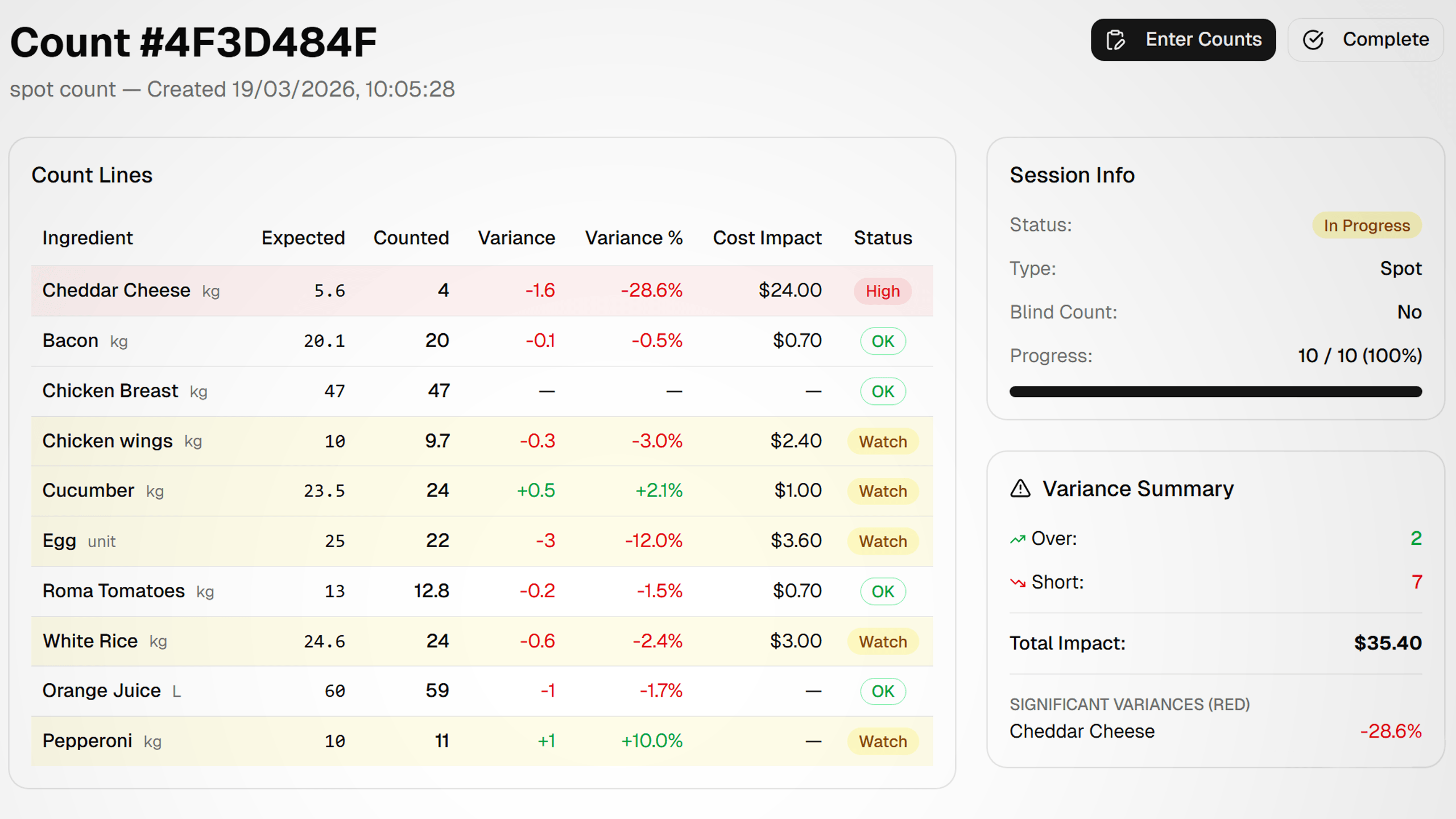
Manual tracking is a slow, error-prone process. Spreadsheets are free until you count the time wasted and money lost. Writing counts on a clipboard and typing them into a computer later introduces transcription errors. Manual systems require hours of administrative work that pull managers away from the floor.
Generic spreadsheet tools were not built for food. Purpose-built restaurant inventory management software like ResLoom IMS is.
Software does the math for you. It updates theoretical counts in real time based on sales. It flags negative variance the moment a shift ends. It digests vendor invoices automatically, adjusting your ingredient costs and menu profitability without manual data entry.
Ditch the clipboard. Use real data.
A Simple System to Start Today
You need a routine. Use this baseline workflow to structure your week.
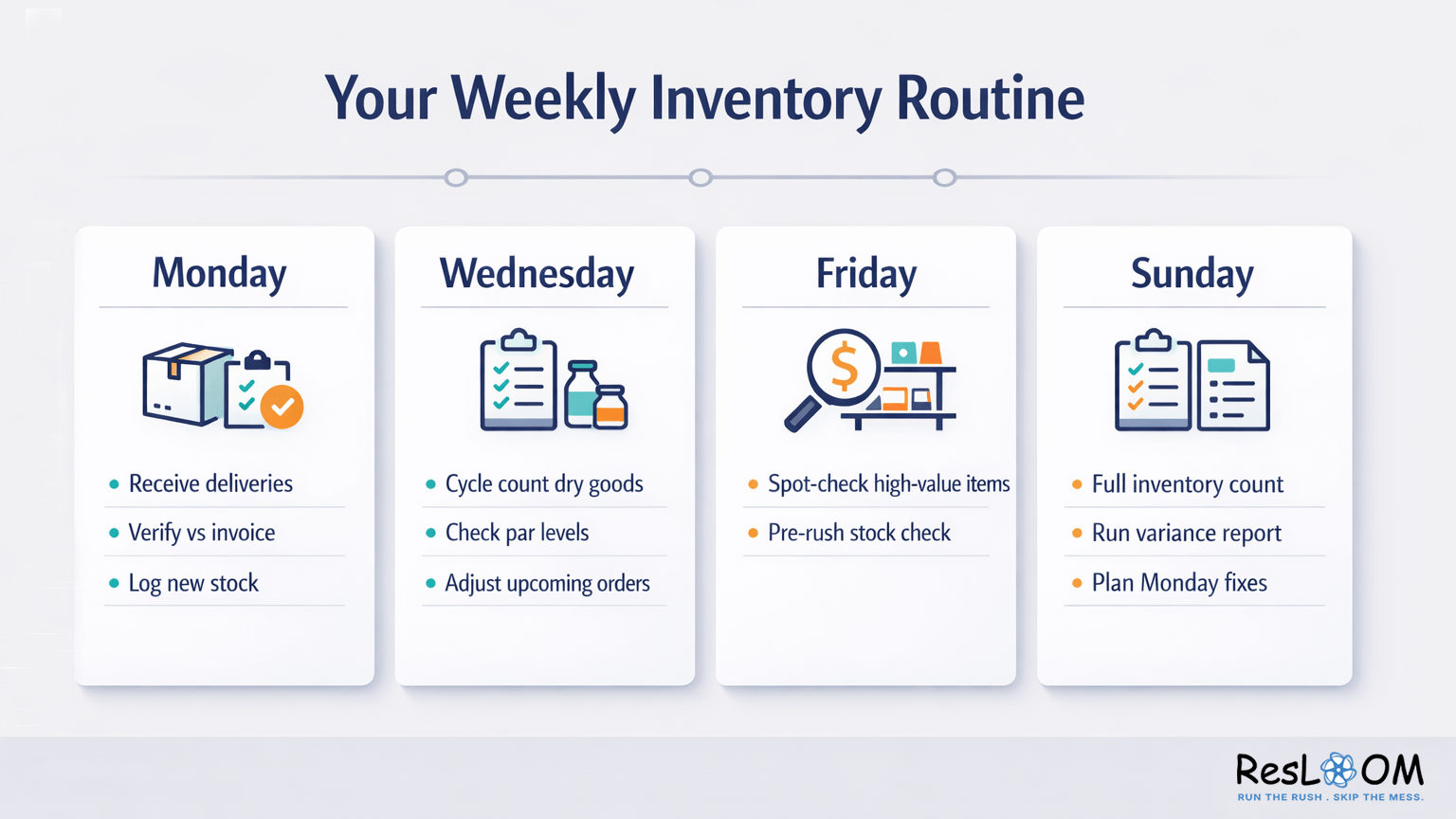
- Monday: Receive weekend orders. Verify quantities against the invoice. Log the new stock immediately.
- Wednesday: Perform a cycle count on dry goods. Check the par levels for the weekend service. Adjust upcoming orders based on current stock.
- Friday: Spot-check high-value items before the dinner rush. Ensure the prep line is fully stocked to prevent mid-shift storage runs.
- Sunday: Run a full inventory count after close. Pull the variance report. Identify discrepancies and plan corrective actions for Monday morning.
Consistency creates control. Follow the routine every week.
Take Control of Your Margins
Stop guessing. Start tracking. Use real data to adjust portions, negotiate supplier prices, update menus, and tighten purchasing. Every decision must be backed by numbers.
Manual Tracking Slowing You Down
Hours lost, money bleeding from missed counts and duplicate orders. Switch to restaurant inventory software built for busy kitchens — setup in 5 minutes, not weeks. Start tracking your stock, slashing waste, and reclaiming thousands this month.
Sources & References
- National Restaurant Association (2024). Restaurant Industry Research. Average full-service profit margins 3–5%; 87% of operators reported food cost increases in 2024; 82% expected further increases in 2025.
- ReFED (2024). Restaurants and Foodservice — Stakeholder Recommendations. 12.5M tons of surplus food generated in 2024; over 85% to landfill.
- ReFED (2024). What Are the Solutions to Food Waste? Waste Tracking (Foodservice) is the top solution by net financial benefit: $2B/year.
Get new guides in your inbox
Practical tips on inventory, food costs, and restaurant operations — no spam.
Frequently Asked Questions
- How often should a restaurant count inventory?
- High-cost items like proteins and alcohol should be counted daily. All other categories should be counted at least once a week using cycle counts. A full physical count should be done at the end of every week to calculate your variance report.
- What is the best way to track restaurant inventory manually?
- Use a printed count sheet organized by storage location. Count items in the same order every time to build speed. Record beginning inventory, add purchases, subtract ending inventory to find actual usage. Compare it to theoretical usage from your POS sales data.
- What is inventory variance in a restaurant?
- Inventory variance is the difference between what your recipes and sales data say you should have used (theoretical usage) and what your physical count shows actually left the shelves (actual usage). A negative variance means you used more than you should have, which signals waste, over-portioning, or theft.
- How do I calculate actual food usage in a restaurant?
- Take your beginning inventory quantity, add any new purchases received during the period, then subtract your ending inventory quantity. The result is your actual usage. Formula: Actual Usage = Beginning Inventory + Purchases − Ending Inventory.
- What are par levels in restaurant inventory?
- Par levels are the minimum quantity of an ingredient you need on hand to get through a service period without running out. They are calculated from your historical sales data and delivery schedule. When stock drops to par, you order enough to bring it back above par.
- Can small restaurants benefit from inventory tracking software?
- Yes — small restaurants benefit more than large ones because every dollar matters more at tighter margins. Software eliminates the manual counting errors and spreadsheet lag that cost small operators the most. It also saves hours of admin work every week that a small team cannot afford to waste.
Was this article helpful?