
How to Reduce Food Waste in Restaurants
TL;DR
Restaurants lose 4–10% of purchased food to waste every shift. Enforce daily inventory counts, FIFO storage, and strict portion control to cut that number fast. Every pound of food saved drops directly to your bottom line.
How Much Food Waste Costs Restaurants
The numbers are severe. At our partner café, over 270 pounds of food went to waste in a single month—enough to fill nine garbage bins. U.S. restaurants and foodservice businesses generated 12.5 million tons of surplus food in 2024, according to ReFED — with more than 85% going straight to landfill or incineration.
Food costs consume 28 to 35 percent of restaurant sales. When you waste food, you inflate that percentage directly. A restaurant with a $1 million annual food budget loses $40,000 to $100,000 a year just on pre-consumer waste. That is profit wiped out before a single plate leaves the kitchen.
The USDA estimates food loss and waste costs the U.S. food system around $162 billion annually at retail and consumer levels alone. You are operating in a high-volume, low-margin environment. Tight stock control is the difference between profit and loss. When you tolerate waste, you accept lower margins.
Stop funding the landfill. Protect your profit.
Waste % = (Total Waste Cost ÷ Total Food Purchases) × 100
- Total Waste CostCost of all food discarded (spoilage, prep waste, plate waste) in the period
- Total Food PurchasesAll food costs purchased during that same period
- Waste %Your waste as a share of spend — industry average is 4–10%, target under 2%
Example: $4,000 waste ÷ $40,000 purchases × 100 = 10% waste rate. Every point you reduce saves $400/month.
$100K
lost per $1M food spend per year
Waste Flow Diagram
This flow shows the common path of food waste in restaurants: inventory without visibility leads to over-ordering, which leads to spoilage and profit loss.
Interactive Tool
How much is food waste costing your restaurant?
Adjust the numbers below — results update instantly.
Quick start — pick your restaurant type:
Total monthly spend on food inventory
For calculating revenue impact percentage
Typical range is 4–10% for restaurants
Be honest — this affects your savings estimate
Monthly Loss
€700
Yearly Loss
€8,400
Recoverable
€2,940
Switching from guesswork to software
Want the full breakdown?
Detailed insights, industry benchmarks, multi-location analysis, and a personalized PDF report.
The Common Causes of Food Waste
Waste does not happen by accident. It happens through poor processes and lack of visibility. You cannot fix a problem you do not track.
Blind Purchasing and Over-Ordering
Gut-feeling purchasing causes over-ordering. Managers look at the walk-in, make a quick guess, and order a surplus just to be safe. That surplus rots. Fresh produce wilts. Meat passes its safe window. You bought it, you stored it, and then you tossed it. Manual counts miss items. Spreadsheets go stale the moment they are saved.
Lack of Portion Control
Over-plating eats margins. Cooks eyeball portions instead of using scales or standard scoops. A half-ounce overage on a premium protein seems small on one plate. Multiplied by two hundred covers a night, it drains your inventory. Customers do not finish oversized portions. The food comes back to the dish pit and goes into the trash.
Poor Storage Protocols
Improper storage accelerates spoilage. Walk-in coolers sit at the wrong temperature. Raw proteins drip onto ready-to-eat produce. Staff push older items to the back of the shelf when putting away a new delivery. The old stock expires in the dark.
Menu Bloat
Too many menu items require too many unique ingredients. When an ingredient is only used in one low-selling dish, it sits on the shelf. The dish does not sell fast enough to justify the prep. The remaining product goes bad.
Practical Ways to Reduce Food Waste
You reduce food waste in restaurants through operational discipline. You enforce strict rules. You measure everything.
Mandate Daily Inventory Counts
Weekly counts leave too much room for error. Daily inventory counts catch problems immediately. You track the exact variance between what you sold and what is missing from the shelves. When a discrepancy appears, you address it that same day.
Enforce Strict FIFO Storage
First In, First Out (FIFO) is non-negotiable. Label everything with a receiving date. Place new inventory behind the older inventory. Train your staff to pull from the front. Audit the walk-in daily to ensure compliance. If items are placed incorrectly, correct the behavior immediately.
Standardize Portions with Hard Metrics
Eliminate guesswork on the prep line. Issue exact portioning tools. Require scales for proteins. Train your kitchen staff to follow the exact weight and measure for every dish. Monitor the dish return station. If plates consistently come back with half-eaten sides, reduce the portion size.
Cross-Utilize Ingredients
Design menus around versatile ingredients. Use vegetable trimmings to make house broths. Turn day-old bread into croutons. If an ingredient only appears in one dish, remove the dish or rewrite the recipe.
Train Staff on Financial Impact
Kitchen staff do not see the invoices. They do not know the cost of a dropped steak or a ruined batch of sauce. Show them the numbers. Connect waste to the health of the business. Set clear waste reduction targets. Hold the team accountable for meeting them.
Measure the waste. Change the behavior.
The Role of Technology in Waste Reduction
Manual processes fail under pressure. High-volume kitchens require speed and accuracy. Technology provides the visibility that clipboards and spreadsheets lack.
The Restaurant Inventory Management System
A restaurant inventory management system digitizes your stock control. It tracks ingredients in real time. It alerts you to approaching expiration dates. It generates exact order quantities based on par levels and historical sales data.
Spreadsheets are free until you count the time wasted and money lost. Generic tools were not built for food. A dedicated restaurant inventory management system stops blind purchasing. It connects directly to your point of sale. When a customer orders a burger, the system deducts the bun, the patty, and the cheese from your virtual stock. You see your exact food costs instantly.
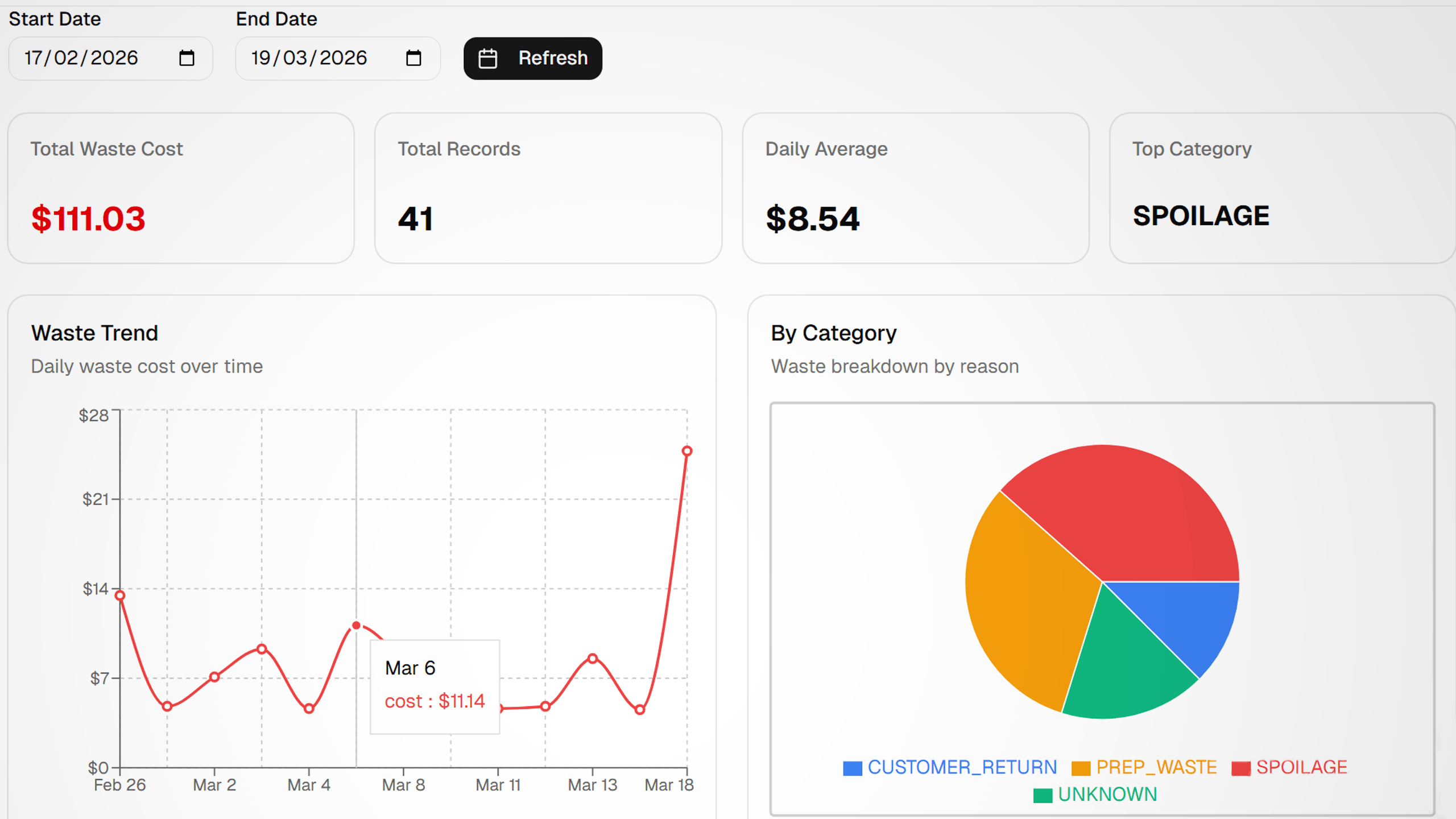
ReFED's Insights Engine ranks waste tracking as the single highest-impact solution for foodservice operators — with a projected $2 billion in annual net financial benefit across the industry. The data is consistent: restaurants that measure waste, reduce it.
Every decision is backed by numbers, not guesswork.
Kitchen Display Systems (KDS)
Paper tickets get lost. Handwriting is misread. A Kitchen Display System (KDS) routes orders clearly and directly to the correct prep stations. It reduces order errors. It eliminates the need to remake dishes due to miscommunication.
A remake is double the food cost and double the labor. KDS stops remakes.
KDS also tracks ticket times. It improves communication between the front and back of house. Your kitchen works faster and makes fewer mistakes.
Bonus: A Simple Waste Tracking System You Can Start Today
You do not need to wait for a software installation to start tracking waste. Implement this manual food waste audit during your next shift.
Step 1: Set Up Waste Stations
Place three distinct, clearly labeled bins in your kitchen.
- Bin 1: Prep Waste (trimmings, peels, stems).
- Bin 2: Spoilage (expired items, dropped food, ruined prep).
- Bin 3: Plate Waste (food returned from the dining room).
Step 2: Weigh the Bins Daily
At the end of the night, place each bin on a receiving scale. Record the exact weight of each category. Write it on a dedicated clipboard.
Step 3: Identify the Problem
Review the log at the end of the week. Look for the heaviest bin.
If Prep Waste is high, your knife skills need work or your produce quality is poor. If Spoilage is high, you are over-ordering or failing to follow FIFO. If Plate Waste is high, your portion sizes are too large or the dish quality is lacking.
Step 4: Take Corrective Action
Address the specific failure point. If spoilage is the culprit, cut your next order by 10 percent. If plate waste is the issue, reduce the side dish portion by one ounce.
Step 5: Repeat the Cycle
Do this every single week. Make waste tracking a mandatory part of the closing checklist.
Find the leak. Stop the loss.
Sources & References
- ReFED (2024). Restaurants and Foodservice — Stakeholder Recommendations. Restaurants and foodservice generated 12.5M tons of surplus food in 2024; over 85% went to landfill.
- ReFED (2024). What Are the Solutions to Food Waste? Waste Tracking (Foodservice) is the top solution by net financial benefit at $2B/year.
- ReFED (2024). How Big Is the Food Waste Problem in the U.S.? 25% of all U.S. food — 60 million tons — goes to waste destinations.
- USDA Economic Research Service. Food Waste FAQs. Food loss and waste at retail and consumer levels equates to ~$162 billion annually (2010 baseline).
Get new guides in your inbox
Practical tips on inventory, food costs, and restaurant operations — no spam.
Stop Guessing and Start Tracking
Food waste will continue to drain your accounts until you decide to stop it. Awareness is not enough. You need action. You need systems.
Manual tracking is a start, but it scales poorly. High-volume environments require automated precision. A dedicated restaurant inventory management system gives you total control over your purchasing, your prep, and your profits.
Ready to turn restaurant waste into profit?
See how real-time inventory tracking and order accuracy protect margins for every shift.
Frequently Asked Questions
- What percentage of food is wasted in restaurants?
- Restaurants typically waste 4–10% of all purchased food before it reaches a customer. This includes prep waste, spoilage, over-production, and plate waste returned from the dining room.
- What is the biggest cause of food waste in restaurants?
- Blind purchasing and improper storage are the two leading causes. Managers who order by gut feeling instead of real data consistently over-order, and without strict FIFO enforcement, older stock spoils before it is used.
- How do I calculate food waste percentage in a restaurant?
- Divide total food waste cost by total food purchases, then multiply by 100. For example, if you waste $4,000 worth of food in a month and your food purchases were $40,000, your waste percentage is 10%.
- What is FIFO and how does it reduce food waste?
- FIFO stands for First In, First Out. It means the oldest inventory is always used before newer stock. Labeling every item with a received date and placing new deliveries behind existing stock ensures nothing expires at the back of the shelf.
- How much money can a restaurant save by reducing food waste?
- A restaurant with $1 million in annual food spend can save $40,000–$100,000 per year by reducing waste from an industry-average 4–10% down to 1–2%. Even small operations see hundreds to thousands of dollars in monthly savings.
- What is the best system to track food waste in a restaurant?
- A dedicated restaurant inventory management system is the most effective solution. It tracks real-time stock levels, flags items approaching their expiration window, and generates purchasing recommendations based on actual sales data — not guesswork.
Was this article helpful?